
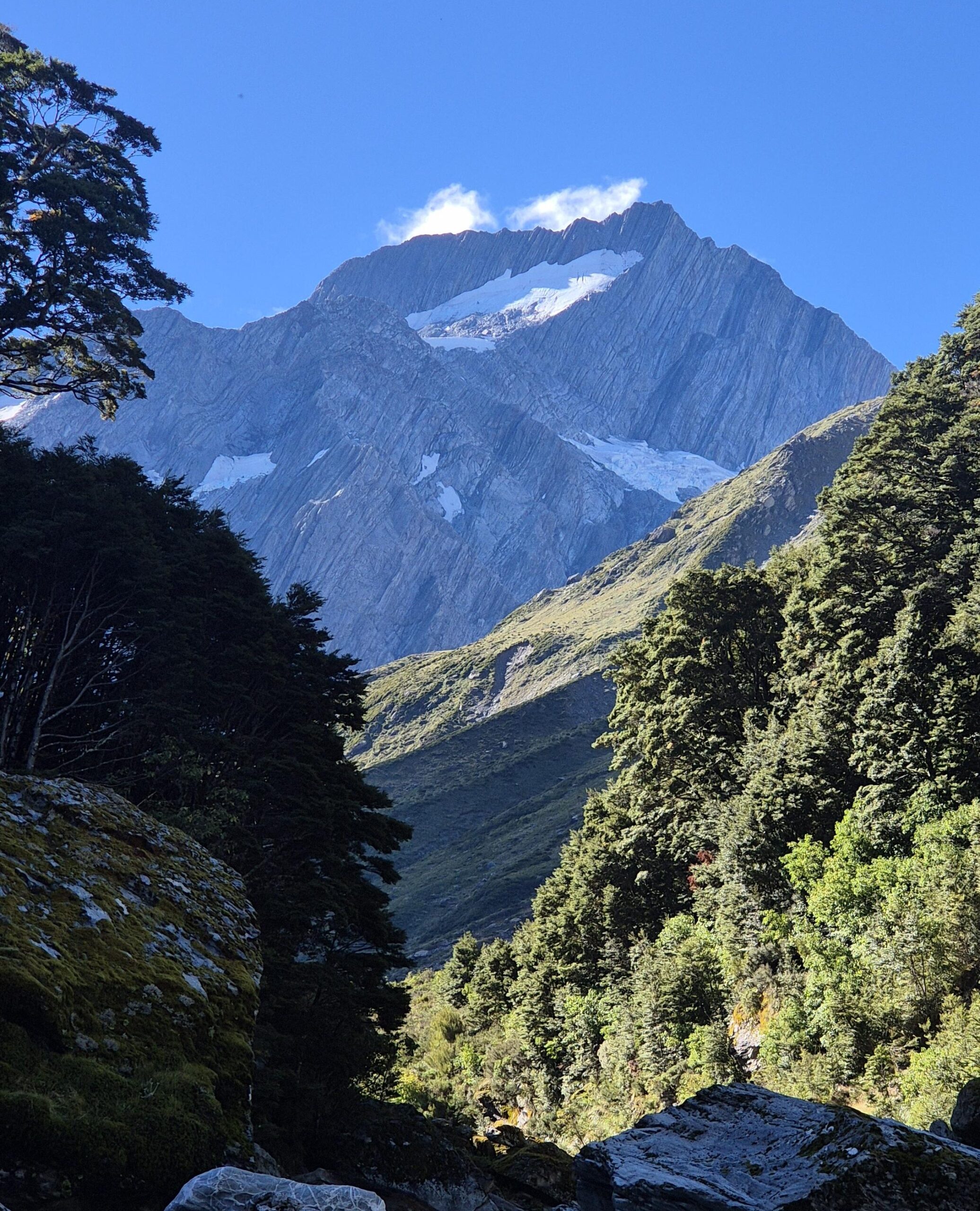
Mt Ward is a striking peak. As you enter the Hopkins Valley near Ram Hill, it stands out as a square-edged summit ridge, the prominent feature, center of frame. Its steep southern aspects stand dark against the sky, the glint of a remnant glacier hanging from its side. It looks distant, but it also looks proud, like a small reflection of its much larger northern neighbour.
I’d been eyeing Mt Ward for a couple of seasons and knew I’d eventually give it a go. The real appeal was a west-to-east traverse, climbing the Northwest Chimney, which supposedly offered good-quality rock and moderate climbing before following the beautiful summit ridge.I knew the eastern side would be considerably chossier, but suspected it wouldn’t be too difficult to descend on-sight. Eventually, everything lined up.
I’d been spending some time learning to ride a motorbike well enough to travel up river valleys, and Mt Ward felt like a pretty good culmination of that process. I’m certainly no motocross rider, but by this point I could hold my own through relatively deep New Zealand rivers on my 250cc farm bike.
Grace and I took one bike, while George and Brooke took the other.
We made quick time up to Elcho Hut, taking around two hours to ride a journey that would roughly be a full day’s travel on foot. The river crossings were the trickiest part. You don’t want to get a motorbike stuck in too strong or deep of a current, dropping the bike can quickly turn an efficient approach into an engine-recovery exercise.
From Elcho Hut, we continued on foot up North Elcho Stream. After around six hours of boulder hopping, stream crossings and general route finding faffery, we made camp about 600m below Elcho Pass.
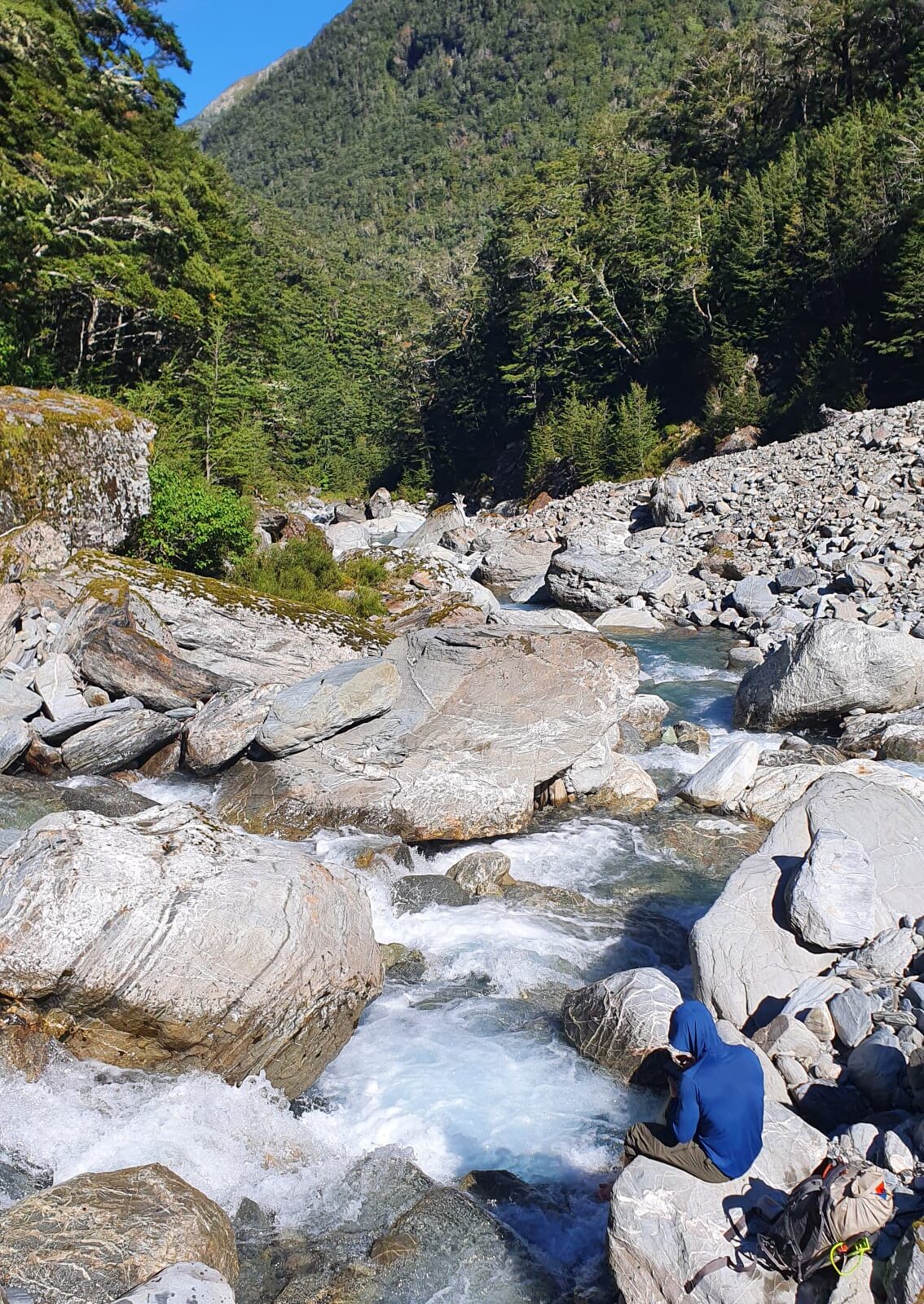
The following morning, we rose early and started towards the traverse. We made reasonable time up to the saddle, although it was hard work on steep scree and tussock. From there, open basins led us around towards the western aspects of Mt Ward and Mt Dundas.
The terrain became more technical as we scrambled upwards and then onto an unnamed remnant glacier on the western slopes of Mt Ward. It is essentially a patch of very firm, old ice. The glacier travel was a little awkward, but there were no particularly deep or daunting crevasses and the obvious obstacles were easy enough to navigate around. By the time we reached the base of the northwest chimney, we’d already been moving for around five hours.
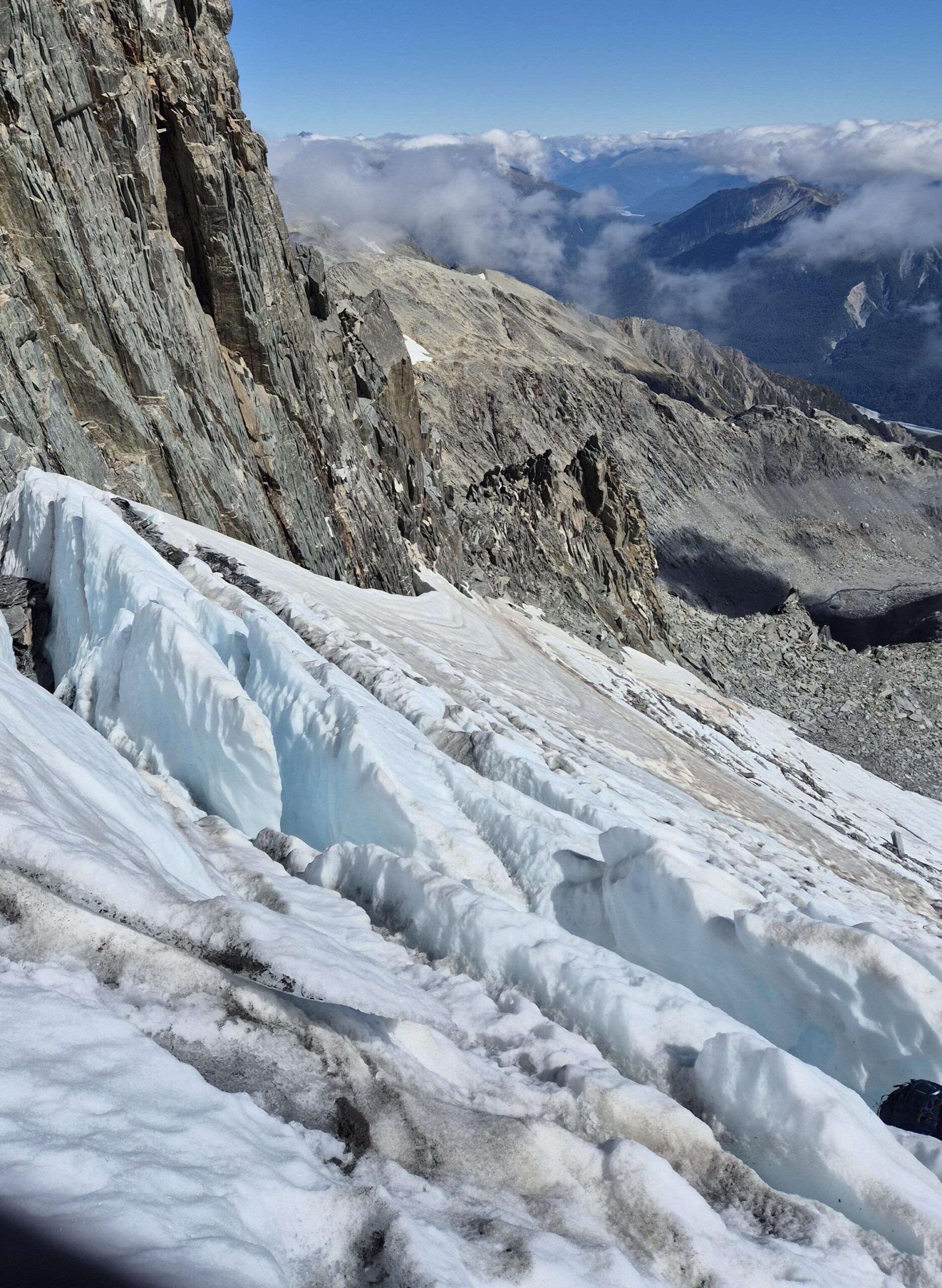
The technical climbing was about to begin.
There was around 150 metres of technical climbing in the chimney. We believed we were following the line of least resistance, although I would assume there are several possible variations, depending on your skill, and equipment.
The climbing itself wasn’t particularly sustained, but it was often runout and good stances for anchors weren’t easy to find. There was one standout Grade 16–17 move, essentially a one-move wonder, which probably felt a little harder than it otherwise would have in mountain boots with a heavy pack. Fortunately, I found one good piece of protection for it.
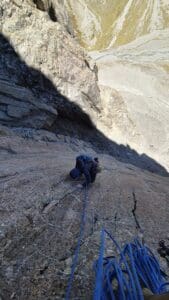
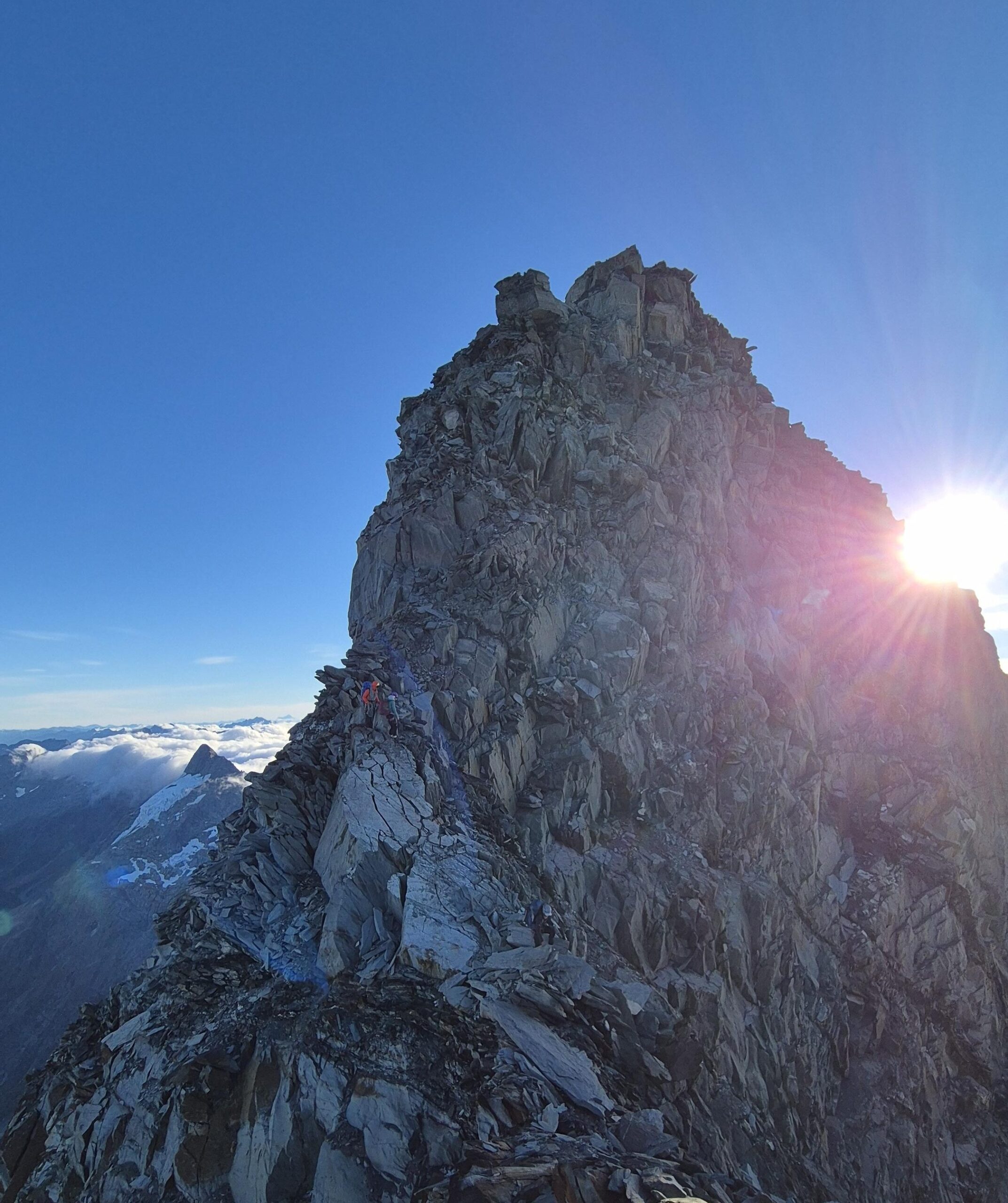
After the chimney, another short section of scrambling brought us to the final pitch to the summit ridge. This was the standout pitch of the route. A beautiful hand crack climbed up and around a small rooflet, with excellent rock and great protection. It was exactly the sort of pitch you hope to find high on a mountain. Once we topped out, we packed the rope away and started along the summit ridge.
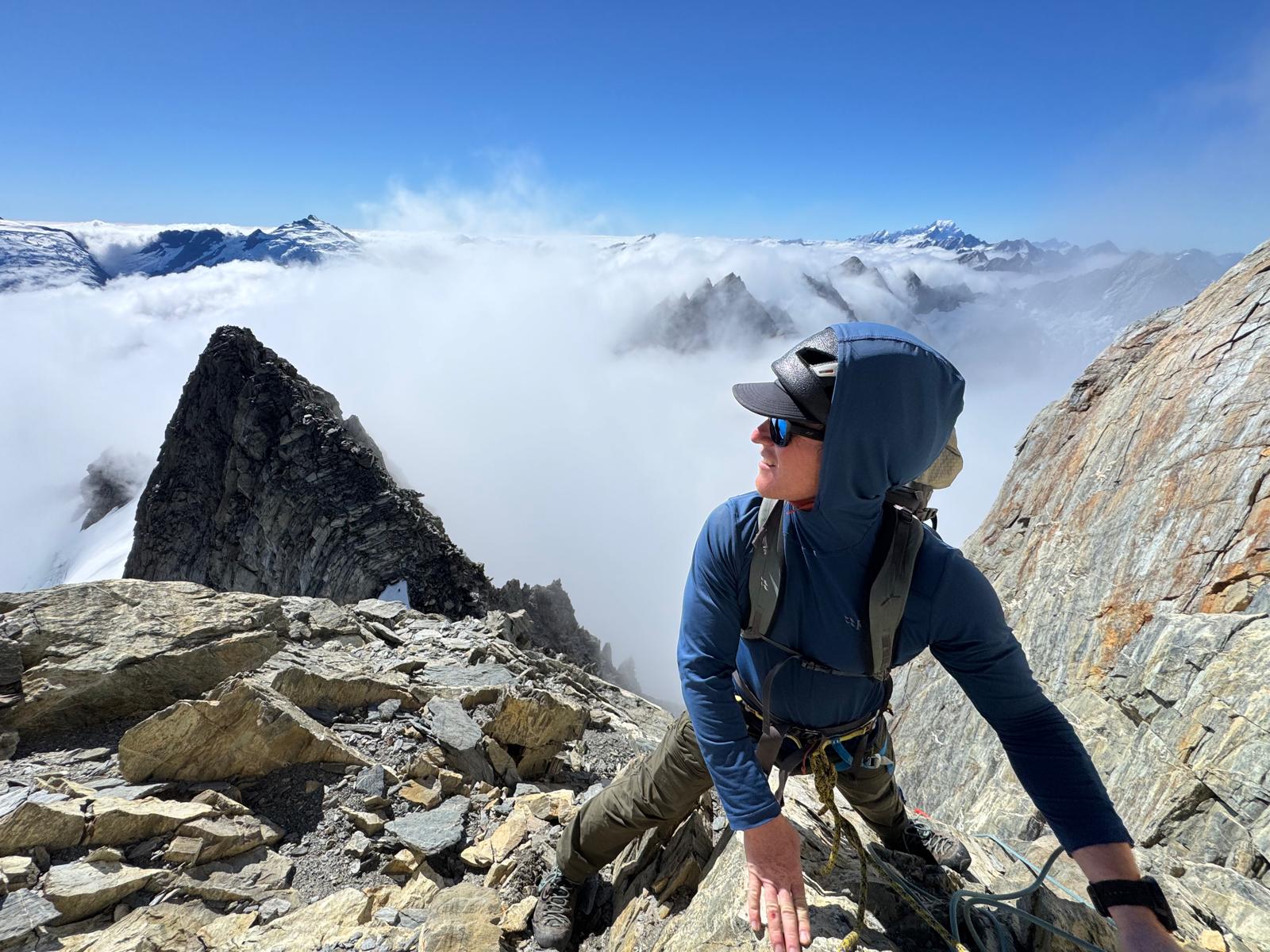
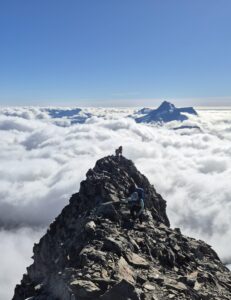
The guidebooks describe parts of the ridge as being wide enough to park a bus on. Depending on what sort of bus you’re talking about, I reckon that’s probably true. For the most part, though, it felt more like walking along a comfortable footpath, albeit one suspended high above the surrounding valleys. It genuinely felt like walking on top of the world.
What followed was one of the most incredible views of the Main Divide I’ve witnessed.
A bank of West Coast jungle mist was spilling over the divide, while above us the sun shone brightly in a completely windless sky. Standing on the broad summit ridge, it felt as though we’d climbed onto the tower of some enormous natural wall.We took our time wandering along the ridge, spending around 45 minutes to an hour enjoying it. Eventually, though, the ridge became more technical again.
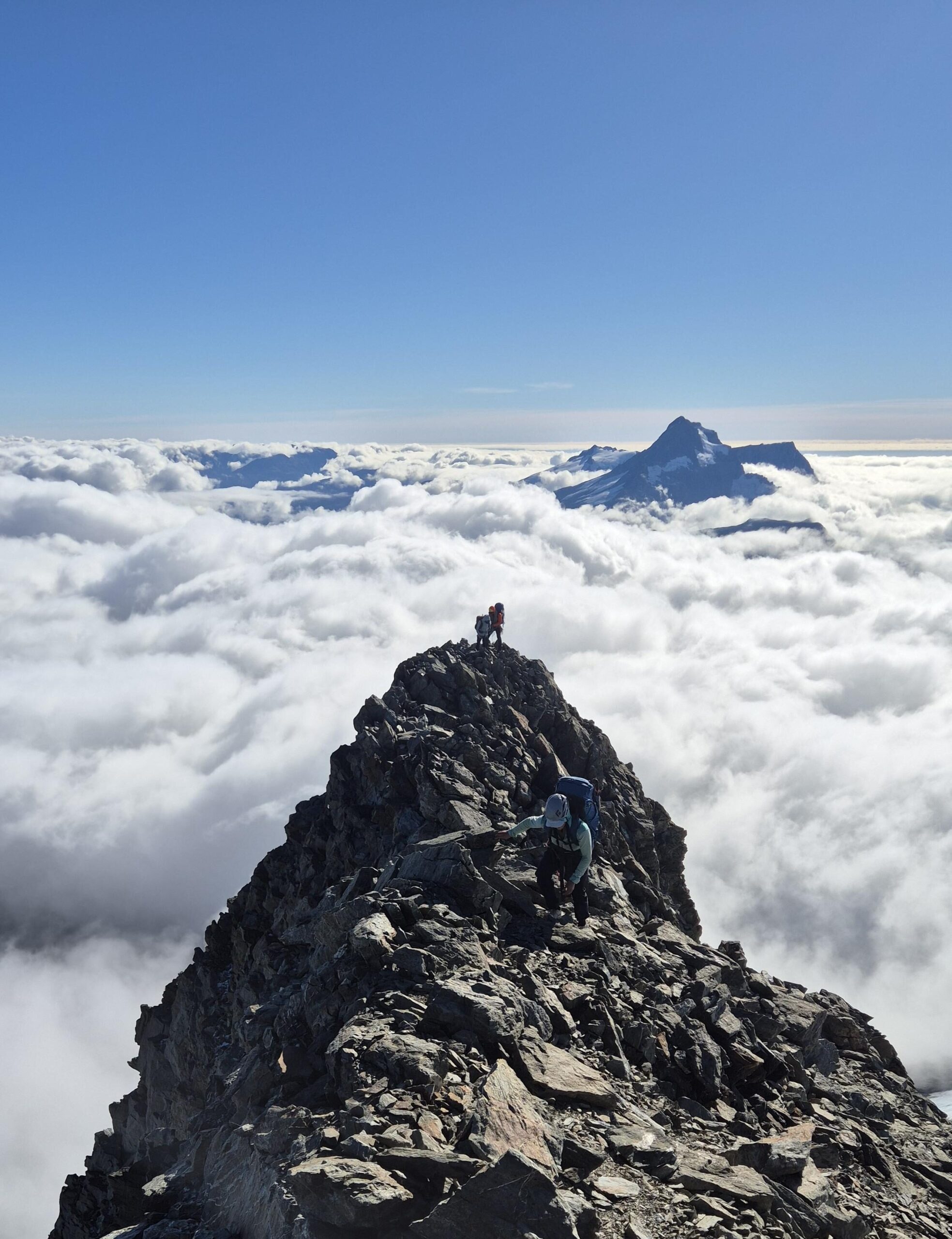
There were some tricky sections of downclimbing and rappelling through an area where it appeared that part of the ridge had fallen away. The rock quality varied considerably, with the northern side tending towards loose choss while the southern side generally offered better rock. Eventually we reached the true summit. From there, it became obvious that the east-ridge descent was going to be considerably looser than the climbing we’d done on the western side.
The group was starting to feel the length of the day, but we rallied and decided to make the most of the remaining daylight. The plan was to tackle as much of the technical descent as possible while we still had light, then find somewhere suitable to sit out the night.
On the final tricky section, there was a roughly 10-metre traverse over a gaping void. The handholds were big and positive, but the feet were little more than scrabbling around on gravel. One of the handholds blew out. I fell away from the face until my protection caught me. I was fine, but it was definitely a scary moment.
Thankfully, we’d soon made it through the technical climbing and were left with fairly easy but fairly exposed downclimbing through hanging benches of scree.
Eventually the daylight disappeared and the head torches came out. About an hour later, we found what looked like our best option for the night. It wasn’t exactly a bivy I’d mark on the map, but it would do.
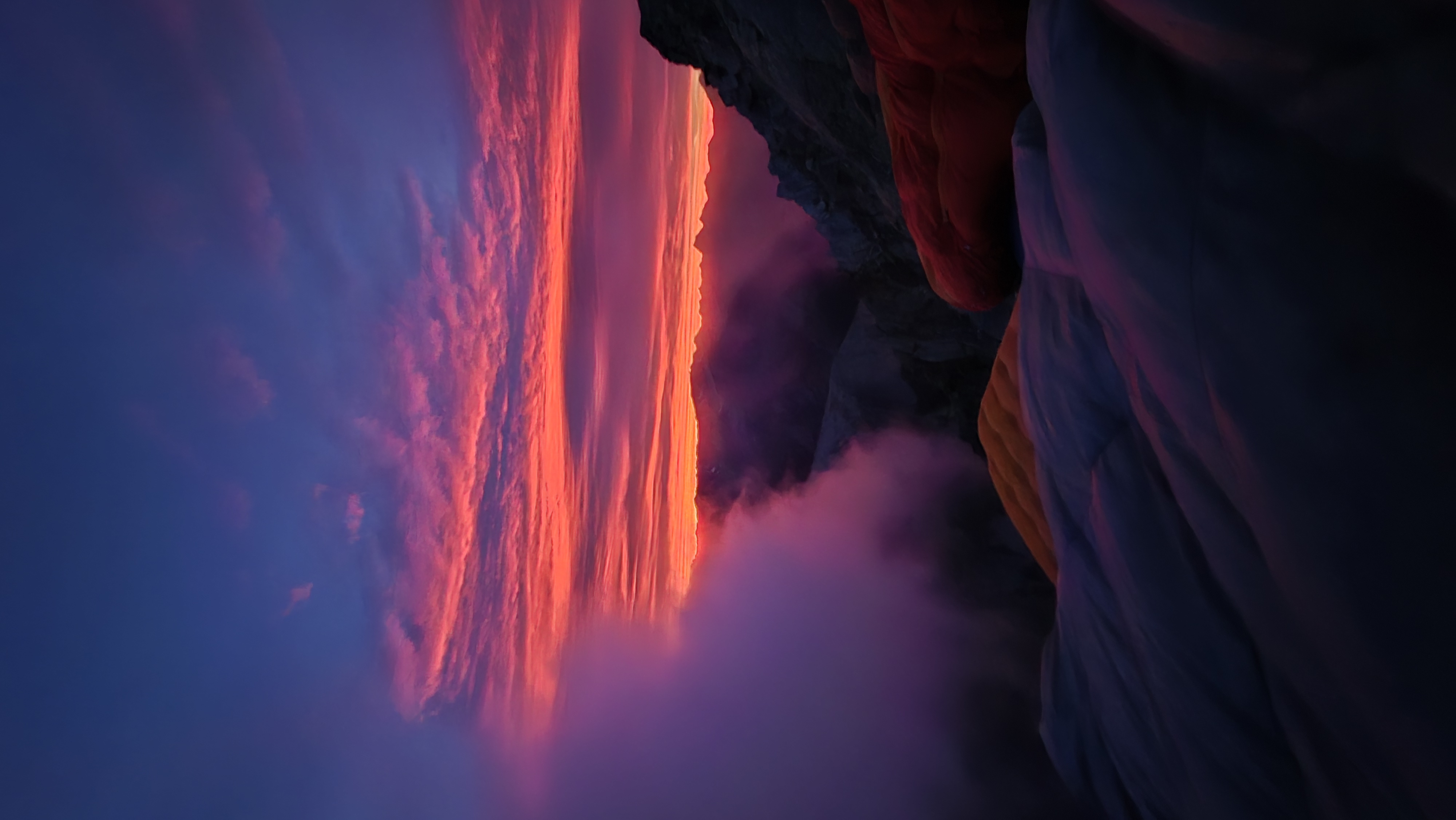
We were able to sit with our backs against a sloping wall, and our legs hanging out over the edge. Each pair built their own anchor, and we clipped ourselves, our gear and everything else in for the night. Fortunately, it was a relatively mild, windless evening, so we weren’t too cold.We managed to scrape together a few hours of sleep.
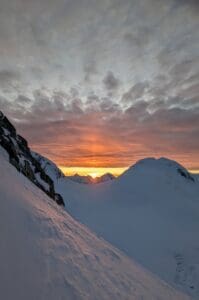
Sleeping high on a mountain has certain benefits. The sunset and sunrise were spectacular, not necessarily because of any single view, but because of the colours, the atmosphere and the unexpected awesomeness of our predicament. There was something pretty special about waking up perched on the side of Mt Ward, being exactly where we were and knowing what we’d just climbed. The following morning, we continued down towards tussock country.
We crossed the remains of the Foster Glacier, which was straightforward enough, and from there the terrain became mostly walking and scrambling.
George and Brooke had another plan.George had carried his paraglider all the way across the mountain, and with conditions looking good, they pulled it out. Happy Birthday Brooke! They launched right in front of us, taking some of our heavier gear with them, and were down in the valley barely ten minutes later.
Grace and I continued our descent on foot. A couple of hours later, George met us on the motorbikes and took us back to Elcho Hut, where we’d left some food for dinner. The following morning, we rode the bikes back down the valley to the car.
Mt Ward was a fantastic trip, easily one of the highest-quality mountain adventures I’ve done in the last few years. I think what made it so good was the breadth of the experience.
The motorbike approach, having Elcho Hut as a base, the remote walk up the North Elcho and finally climbing a summit ridge I’d been staring at for several seasons all added something to the trip.
The climbing itself was engaging and fun, the summit ridge was spectacular, and the descent provided just enough uncertainty and adventure to keep things interesting.
Throw in an unplanned bivouac high on the mountain, a spectacular sunrise, and two friends flying a paraglider off the descent, and it becomes a pretty hard trip to beat.
Mt Ward is a stunning mountain with a stunning climb, and in my opinion it deserves to be considered a classic.